
1970 AMC Rebel “The Machine” – 22 Facts You Should Know
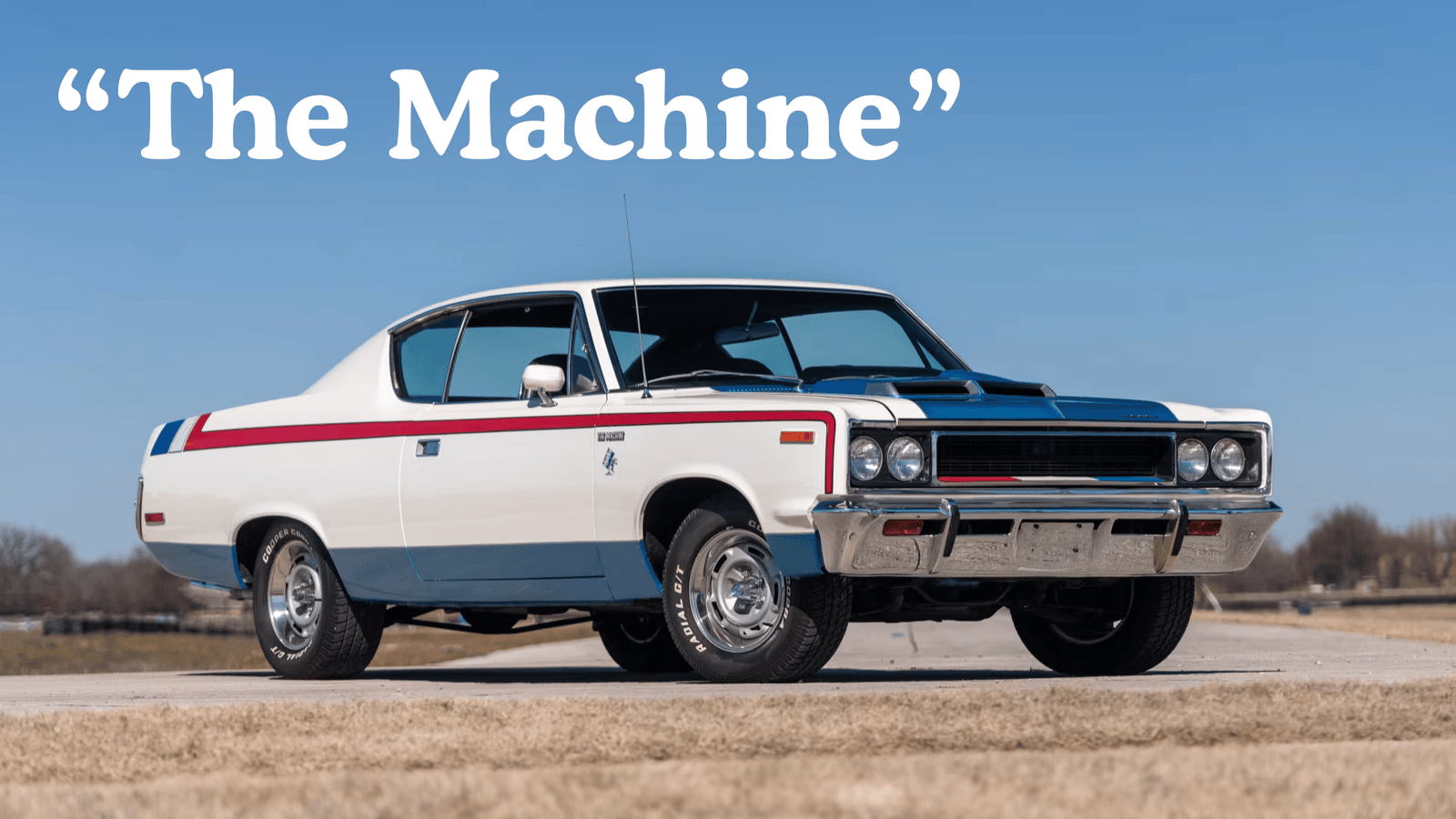
You pull up next to one at a light, white body blazing with blue and red stripes, hood scoop jutting up like it’s ready to swallow the sky whole. That hood-mounted tach visible through the windshield tells you everything before the driver even touches the gas. This wasn’t just another muscle car trying to play catch-up with Detroit’s big boys. This was AMC throwing down with everything they had, building something that could run with GTOs and SS 396s while looking like nothing else on the road.

Image: Mecum Auctions
The Machine represented AMC’s full-throated answer to the muscle car wars, a car that mixed raw performance with styling so bold it bordered on audacious. While the Big Three automakers churned out tire-shredding monsters by the thousands, American Motors built something different. Something that weighed less, cost less, and didn’t apologize for being the scrappy outsider in a fight dominated by giants.
AMC’s Direct Shot at Detroit’s Muscle Car Royalty
The Machine existed for one reason: to prove AMC could build a legitimate muscle car that competed head-to-head with the Pontiac GTO, Chevrolet SS 396, and Plymouth Road Runner. American Motors wasn’t playing around with half-measures or dressed-up commuter cars. They took their Rebel platform and transformed it into something that could legitimately hang with anything coming out of Detroit, a car that announced its intentions before the engine even fired up.
Walking around one, you notice how the proportions work. The car sits lower than you’d expect, the body tighter and more compact than the bloated muscle cars that were already starting to swell in 1970. AMC knew they couldn’t outspend or out-manufacture the competition, so they built something that felt more focused, more purposeful. The Machine wasn’t trying to be the biggest or the loudest. It just needed to be fast enough and distinctive enough to matter.
This wasn’t some marketing department’s fantasy either. The performance hardware backed up the visual theater, with actual go-fast parts installed as standard equipment rather than expensive options that inflated the sticker price beyond what most buyers could stomach. You got the whole package without emptying your bank account on the options sheet.
The Most Potent V8 AMC Ever Built

Image: Mecum Auctions
Under that ram-air hood sat the most powerful engine AMC would ever offer in a production vehicle, a 390 cubic inch V8 that represented the absolute peak of what the company’s engineers could extract from their largest displacement motor. This wasn’t a motor destined for station wagons or luxury barges. This was AMC’s performance engine, period.
The 390 in the Machine differed significantly from the standard versions found in other AMC products. Special cylinder heads flowed air more efficiently. The camshaft featured a more aggressive profile that kept the valves open longer and lifted them higher. The intake and exhaust systems were completely redesigned to support higher RPM operation. Everything about this motor screamed performance, from the heavy-duty internals to the way it idled with that lumpy, aggressive cam lope that told everyone within earshot this wasn’t your neighbor’s Matador.
AMC rated this beast at 340 horsepower at 5,100 rpm, with 430 pound-feet of torque arriving at 3,600 rpm. Those numbers put it squarely in the hunt with everything else in the muscle car arena, though some suspected AMC might have been conservative with their ratings. The torque curve hit hard and early, typical of big-cube American V8s, but the engine’s willingness to rev separated it from lazier motors that ran out of breath above 4,500 rpm.
Performance Parts That Actually Made a Difference
That 340 horsepower didn’t come from marketing spin or optimistic dyno sheets. AMC boosted the 390 from its standard 325 hp rating through special cylinder heads, a performance-tuned cam, and redesigned intake and exhaust systems, all working together to make more power across the entire rev range. The heads flowed better, simple as that. More air in, more exhaust out, more power everywhere.
Feeding this motor was a Motorcraft four-barrel carburetor rated at 690 cubic feet per minute. That’s a serious carburetor, the kind that could support way more than 340 horsepower if you really wanted to push things. The carb sat underneath that ram-air hood scoop, which used a large rubber gasket to seal the air cleaner assembly directly to the hood. Cold air rushed straight into the intake, bypassing the heat-soaked engine bay entirely. On a cool morning, you could feel the difference when the throttle opened up.
The exhaust system wasn’t some afterthought either. Larger diameter pipes, less restrictive mufflers, and a design that prioritized flow over silence. The Machine sounded like a muscle car should, with a deep rumble at idle that turned into a full-throated roar under acceleration. You didn’t need to tell people this car was fast. They could hear it coming three blocks away.
Red, White, and Blue Like Nothing Else on the Road

Image: Mecum Auctions
The Machine’s paint scheme remains one of the most recognizable designs in muscle car history. White body. Massive blue stripe running the length of the hood. Bold red, white, and blue reflective stripes manufactured by 3M wrapping around the front, sides, and rear. This wasn’t subtle. This wasn’t trying to blend in with the crowd at the shopping mall. This was AMC planting a flag and daring you to look away.
Those reflective stripes caught light in ways regular paint never could, glowing at night when headlights hit them just right. The effect was almost psychedelic in the right conditions, the stripes seeming to float above the body panels. Some people loved it. Some people thought it was the tackiest thing Detroit had ever produced. Nobody ignored it.
The patriotic theme fit the late 1960s zeitgeist perfectly, even if the cynical marketing calculation was obvious. Red, white, and blue sold cars in 1970, especially to buyers who wanted their muscle car to make a statement beyond just going fast. The Machine delivered that in spades, looking like it had just rolled off the factory floor after winning an unlimited-budget custom paint contest.
First 1,000 Units Built to Identical Specifications
AMC took an unusual approach with early Machine production. The first 1,000 units were completely identical, every single one painted white with blue and red, white, and blue reflective tape stripes. No options. No variations. No special requests. If you wanted one of the first Machines, you got exactly what AMC decided to build.
This strategy simplified production and created instant recognition for the model. Every Machine looked like every other Machine, building a consistent visual identity that made the car instantly recognizable regardless of where you saw it. The Big Three couldn’t match that kind of focused identity because they offered too many options, too many configurations, too many ways for the basic concept to get diluted.
After those first 1,000 units, AMC opened up the options, allowing buyers to select different colors and equipment packages. But those initial cars remain the most collectible, the purest expression of what AMC intended when they conceived the Machine. Identical in every way, built to a single standard, focused entirely on performance and presence.
Thirty Matador Red Machines That Almost Nobody Knows About
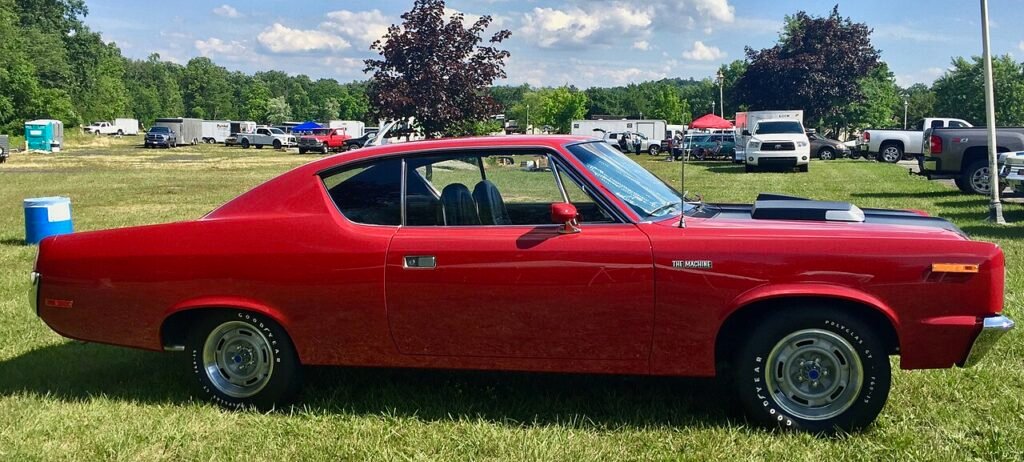
Buried in the production numbers sits a fascinating footnote: only 30 Machines were painted in AMC’s Matador Red color. These cars remain incredibly rare, far more unusual than the standard white-and-blue cars that defined the model. Finding one today borders on impossible, with most collectors never having seen an example in person.
Why so few red cars? The details get murky. Some suggest these were special orders. Others think they were built as dealer demonstrators or promotional vehicles. A few might have been executive cars. Whatever the reason, AMC’s production records show just 30 Machines finished in Matador Red, making them among the rarest muscle cars of the era.
These red cars didn’t feature the same graphics package as the standard white Machines. The whole red, white, and blue stripe scheme didn’t translate to a red body, so the graphics had to be reworked or eliminated entirely. Most Matador Red Machines received simplified stripe packages or none at all, relying on the car’s stance and hardware to communicate its performance credentials.
Ram-Air Hood Scoop That Actually Worked
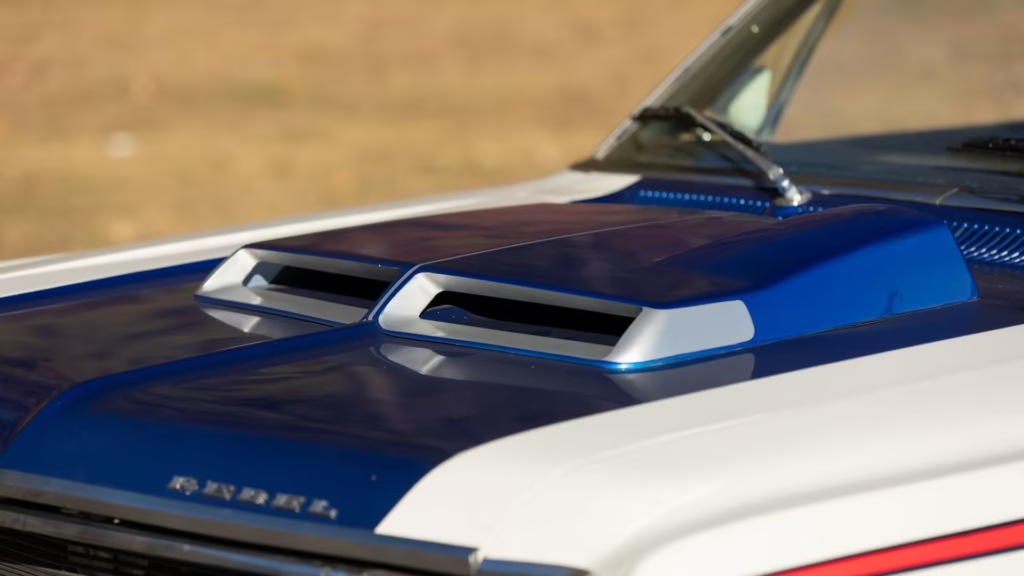
Photo: Mecum Auctions
That enormous hood scoop wasn’t just for show, though it certainly looked aggressive jutting up from the hood like it was trying to catch low-flying aircraft. The scoop featured a cold air package that used a large rubber gasket to seal the air cleaner assembly to the hood, creating a direct path for outside air to flow into the carburetor without passing through the hot engine compartment.
Cold air is denser than hot air, which means more oxygen molecules per cubic inch, which translates directly to more power. On a cool fall evening with temperatures in the 50s or 60s, that ram-air system could add a noticeable bump in performance compared to a conventional air cleaner setup breathing superheated underhood air. Some owners reported the difference felt like 10 or 15 horsepower, though nobody was running precision dyno tests in 1970.
The scoop also housed something you don’t see on modern cars: a hood-mounted tachometer visible to the driver through the windshield. This tach sat right on top of the scoop, angled back toward the driver’s position, allowing you to monitor engine speed without taking your eyes too far off the road. The placement was pure theater, a visual declaration that this car cared about performance first and everything else second.
Hood-Mounted Tach Made the Statement Clear

Photo: Mecum Auctions
That tachometer on the hood scoop served a practical purpose, but its real function was psychological. It announced to everyone, including the driver, that this machine monitored engine performance in real time, that shift points and redlines mattered here. You couldn’t miss it, couldn’t ignore it, couldn’t pretend this was anything other than a performance-focused automobile.
The tach faced the driver at an angle that made it readable through the windshield, though glare could be an issue on bright sunny days. Reading it required a quick upward glance, which some drivers found distracting. Others loved the constant reminder that they were piloting something special, something that cared enough about engine speed to mount a dedicated gauge in one of the most prominent positions on the entire car.
Modern cars hide their performance equipment behind subtle badges and optional carbon fiber trim. The Machine put it all on display, making sure everyone understood exactly what they were looking at. That hood tach communicated the car’s purpose more effectively than any advertisement or brochure ever could. You saw it, you knew what you were dealing with, and you either got out of the way or prepared to race.
6.4 Seconds to 60 MPH Ran With the Best of Them
The Machine could hit 60 mph from a standstill in 6.4 seconds, with a top speed of 127 mph. Those numbers put it squarely in the performance ballpark with Chevrolet’s SS 396, Pontiac’s GTO, and Plymouth’s Road Runner. This wasn’t some also-ran trying to fake its way into the muscle car club. This was a legitimate performance machine that could run with anything the Big Three offered.
That 6.4-second sprint required skill to achieve. You needed to dump the clutch at just the right RPM, modulate the throttle to manage wheelspin, and nail the shift points between gears. Do it right, and the Machine launched hard, squatting on its rear suspension and clawing forward with serious authority. Do it wrong, and you either bogged the engine or lit up the tires in a cloud of smoke that looked impressive but didn’t help your elapsed time.
The 127 mph top speed came courtesy of decent aerodynamics for a brick-shaped muscle car and an engine willing to rev high enough to pull the car through the air at truly illegal velocities. Few owners ever saw that number on an actual speedometer, but knowing the capability existed added to the Machine’s credibility. This wasn’t a car that ran out of steam at 90 mph. This was a machine that would keep pulling, keep accelerating, until physics or courage gave out.
Borg-Warner Four-Speed or Three-Speed Automatic
Buyers chose between two transmission options: a Borg-Warner T-10 four-speed manual with a Hurst shifter, or a three-speed automatic with a console-mounted lever. The manual was the enthusiast choice, offering complete control over engine speed and gear selection. That Hurst shifter felt solid, mechanical, purposeful. Short throws, positive engagement, a satisfying mechanical click as each gear locked into place.
The T-10 transmission was a proven unit, capable of handling the 390’s torque output without grenading itself during hard acceleration runs. Gear ratios were well-spaced, allowing the engine to stay in its power band through the lower gears before stretching out in fourth for highway cruising. The clutch required a firm push, heavier than most modern cars but typical for a big-cube muscle car expected to survive repeated hard launches.
The automatic was no slouch either, despite the traditional muscle car bias toward manual transmissions. Three speeds might sound limiting compared to modern six or eight-speed automatics, but the ratios worked well with the 390’s broad torque curve. First gear got you moving hard, second kept the engine singing, and third settled things down for cruising. The automatic sacrificed some driver engagement but delivered consistent performance regardless of skill level.
Dana Limited-Slip Differential for Maximum Traction
Standard rear-end ratios were 3.54:1 for manual-equipped cars and 3.15:1 for automatics, but serious buyers upgraded to the Dana Twin-Grip limited-slip differential with a 3.90:1 ratio. That limited-slip made a huge difference in real-world driving, especially when launching hard or attacking corners with enthusiasm. Instead of spinning one tire uselessly, the Dana unit sent power to both rear wheels, doubling your traction and launching you forward with authority.
The 3.90:1 gearing sharpened throttle response and improved acceleration at the expense of highway cruising comfort. With that ratio, the engine spun faster at any given road speed, which meant more noise and slightly worse fuel economy. But the performance gain was worth it for anyone buying a Machine to actually use its performance. The car felt more responsive, more eager, more willing to jump forward when you squeezed the throttle.
Dana built some of the strongest rear axles in the business, and the Twin-Grip differential in the Machine proved durable even under hard use. Guys who drag raced these cars found the Dana unit could survive repeated hard launches better than many competing designs. The gears meshed tight, the differential handled power distribution smoothly, and failures were rare unless someone really abused the equipment or pushed power levels far beyond stock.
Bucket Seats and Disc Brakes Came Standard

Image: Mecum Auctions
Unlike many muscle cars where performance equipment cost extra, the Machine offered bucket seats, disc brakes, big tires, and styled wheels at no extra cost. You bought the car, you got the equipment. No painful options sheet, no dealer markup, no surprise costs when you tried to add the parts that made the car actually work as a performance machine.
Those bucket seats held you in place better than bench seats, though by modern standards they offered minimal lateral support. The upholstery was decent quality for 1970, not luxury-car plush but not cheap vinyl that cracked after six months either. The seats positioned you low in the car, giving a better view of the road and creating a more driver-focused environment than the living room seating found in most American cars.
The disc brakes up front represented a significant safety upgrade over four-wheel drums. Muscle cars were fast, but stopping them required real braking hardware. Those front discs resisted fade better than drums, provided better modulation, and delivered more confident stops from high speeds. The rear drums handled their share of the work, but the front discs did the heavy lifting when you really needed to scrub off speed in a hurry.
Performance Hardware Without the Performance Price Tag
AMC included all that performance equipment as standard because they understood the market. Buyers cross-shopping muscle cars compared prices constantly, and tacking thousands of dollars in mandatory options onto the base price killed deals. By bundling everything together, AMC kept the out-the-door cost competitive while ensuring every Machine left the dealership fully equipped.

Image: Mecum Auctions
The styled wheels looked good and saved unsprung weight compared to steel wheels. The big tires provided grip and filled the wheel wells properly. The ram-air hood scoop and mounted tachometer came standard on every car. You didn’t pay extra for these features. They were part of the package, baked into the price, included because AMC decided that’s what the Machine needed to compete.
This approach simplified the buying process and prevented dealers from playing games with options packages. You couldn’t order a stripped Machine to hit a lower price point, and you didn’t need to max out the options sheet to get a properly equipped car. Every Machine was a Machine, built to the same standard, ready to run with anything Detroit threw at it.
Built to Challenge the SS 396, GTO, and Road Runner
The competitive landscape in 1970 was brutal. Chevrolet’s SS 396 sold thousands of units. Pontiac’s GTO defined the muscle car segment. Plymouth’s Road Runner offered serious performance at budget prices. AMC faced established competitors with huge dealer networks, massive marketing budgets, and decades of brand loyalty. The Machine had to be good enough to overcome all those disadvantages.
Performance-wise, it delivered. The 6.4-second 0-60 time matched or beat most competitors. The handling, while not sports-car precise, kept up with other muscle cars. The styling grabbed attention in ways a Chevelle or GTO couldn’t. The price came in competitive with everything else in the segment. On paper, the Machine checked every box.
But market share proved harder to capture than performance specs. AMC dealers lacked the foot traffic of Chevy or Pontiac stores. Marketing budgets couldn’t match the Big Three’s advertising blitzes. Brand perception worked against AMC, with many buyers viewing them as the economy car company rather than a performance brand. The Machine proved AMC could build a muscle car. It couldn’t prove people would buy one in numbers large enough to matter.
Redesigned Rebel Platform With Updated Styling
The 1970 Rebel featured extensive exterior changes from previous years, including a new grille, wrap-around taillights, updated decklid, and revised trim and ornamentation. The overall shape remained similar to 1967-1969 Rebels, but the details transformed the car’s appearance into something more modern and cohesive.
That new grille sat lower and wider, giving the front end a more aggressive stance. The wrap-around taillights followed the body contour more smoothly, creating a cleaner rear view. The decklid received new stamping with a subtle ducktail spoiler effect that improved aerodynamics slightly while adding visual interest. All these changes combined to make the 1970 Rebel look like a new car rather than a warmed-over previous model.
The Machine benefited from these updates, with the cleaner styling providing a better canvas for the bold graphics package. The proportions worked well, the stance looked right, and the overall package came together in a way that earlier Rebels never quite achieved. AMC’s designers created something that looked purposeful and modern, a legitimate muscle car rather than a compact car pretending to be something it wasn’t.
Upgraded Four-Link Rear Suspension System
AMC eliminated the old torque tube design in favor of an open driveshaft with a four-link, trailing-arm rear live axle suspension system. This change improved ride quality and handling simultaneously, providing better control over rear axle movement while allowing the coil springs to do their job without fighting archaic suspension geometry.
The torque tube design dated back decades and created packaging compromises while limiting suspension tuning options. The new four-link setup used two upper control arms and two lower control arms to locate the rear axle precisely, preventing unwanted movement during acceleration, braking, and cornering. Coil springs provided the spring rate, while shock absorbers controlled motion. The system worked significantly better than the old design.
For performance driving, this suspension upgrade meant the rear end stayed planted more consistently during hard acceleration. Instead of the axle wrapping up and causing wheel hop, the four-link system kept everything aligned and transferring power to the ground. The ride quality improved too, with the coil springs providing a more compliant response to road irregularities compared to the harsher leaf spring setups many competitors used.
Wider Track for Better Stability
The front and rear track increased from 59 inches to 60 inches, spreading the wheels farther apart for improved stability and handling. That extra inch on each side might not sound like much, but it lowered the center of gravity slightly and increased the car’s resistance to body roll during cornering.
A wider track reduces weight transfer during lateral acceleration, which means the tires maintain better contact with the road surface. Better contact equals more grip, which translates to higher cornering speeds and more confident handling. The Machine wasn’t trying to be a sports car, but improved handling made it a better overall performance vehicle.
The wider track also filled the wheel wells more completely, improving the car’s visual stance. Muscle cars looked better with wide tires pushed toward the fenders, creating an aggressive, planted appearance. That extra inch helped the Machine look the part of a serious performance car rather than a sedan with a big engine stuffed under the hood.
Collapsible Steering Column for Safety
The 1970 Rebels featured a safety-oriented instrument panel with a collapsible steering column designed to protect occupants during frontal impacts. The column collapsed on impact rather than spearing through the driver’s chest, a significant safety improvement over earlier rigid designs that caused horrific injuries in crashes.
This safety equipment was federally mandated by 1970, but AMC integrated it better than many competitors. The collapsible mechanism worked reliably without adding slop to the steering feel under normal driving conditions. The instrument panel grouped gauges and controls in a hooded binnacle in front of the driver, improving visibility while creating a more purposeful driving environment.
Muscle car buyers in 1970 cared more about horsepower than safety equipment, but the collapsible steering column represented real progress in automotive safety. Combined with seat belts and a stronger passenger compartment, these features made the Machine safer than earlier muscle cars that treated occupant protection as an afterthought. You still wouldn’t want to crash one, but your odds of survival improved significantly compared to 1960s cars.
Just Over 3,300 Pounds of Muscle
The Machine weighed 3,307 pounds, making it lighter than many competing muscle cars from the Big Three. That weight advantage translated directly to better acceleration and handling, as the 390 V8 had less mass to accelerate and the suspension had less weight to control during cornering.
Weight was power in 1970, but less weight was better than more power in many situations. A lighter car accelerated harder with the same horsepower. It stopped shorter with the same brakes. It turned quicker with the same suspension. The Machine’s relatively compact dimensions and lighter weight compared to bloated competitors like the Chevelle or Torino gave it an advantage that raw horsepower numbers didn’t always capture.
AMC achieved this weight advantage through smaller overall dimensions and less sound deadening material compared to luxury-oriented competitors. The Machine wasn’t trying to be quiet or comfortable. It was built to be fast, and every pound saved contributed to that goal. The standard six-cylinder Rebel two-door hardtop weighed just 3,110 pounds, and even with the heavy V8 and performance equipment, the Machine stayed under 3,400 pounds.
Fighting for Market Share in a 400,000-Unit Segment
The muscle car market exploded in the late 1960s, with projections showing over 400,000 units selling in 1969 alone. AMC wanted a piece of that action, but capturing market share from entrenched competitors required a car good enough to overcome customer loyalty, dealer network disadvantages, and brand perception issues.
The Machine represented AMC’s best effort to crack that market, combining legitimate performance with distinctive styling and competitive pricing. But even a good car faced tough odds against Chevrolet’s massive dealer network and Pontiac’s performance image. AMC dealers didn’t stock multiple Machines the way Chevy dealers kept several SS 396s on the lot. Buyers couldn’t easily comparison shop or test drive multiple cars.
Sales numbers reflected these challenges. While the Machine earned respect from enthusiasts and automotive journalists, it never achieved the sales volumes AMC needed to justify continued production. The muscle car market contracted in the early 1970s as insurance rates soared and emissions regulations tightened. AMC’s timing was unfortunate, entering the market just as the party was ending.
Smaller and Lighter Than Bloated Big Three Competitors
While competitors from Ford, GM, and Chrysler were growing larger and heavier with each redesign, the Machine remained compact and relatively lightweight. This sizing philosophy worked against AMC in the short term, as buyers in 1970 equated size with value. But the smaller dimensions made the Machine more maneuverable and easier to live with as a daily driver.
Parking a Machine was easier than parking a full-size muscle car. The tighter wheelbase made it more responsive in corners. The lower weight reduced tire wear and brake wear. These practical advantages mattered more in real-world driving than most buyers realized, but they rarely influenced purchasing decisions in the testosterone-fueled muscle car market.
AMC’s smaller cars also aged better than their bloated competitors. A 1970 Chevelle feels huge and unwieldy by modern standards. A Machine feels closer to contemporary muscle car sizing, more manageable and less like piloting an aircraft carrier through city traffic. That more reasonable size makes surviving Machines easier to own and drive today, contributing to their growing collector appeal.
690-CFM Motorcraft Four-Barrel Delivered Precise Fuel Metering
That Motorcraft four-barrel carburetor rated at 690 cubic feet per minute was a serious piece of hardware, capable of flowing enough air and fuel to support way more than the 390’s rated 340 horsepower. The CFM rating indicated how much air the carburetor could flow at wide-open throttle, and 690 CFM was enough to feed engines making 450-500 horsepower with proper tuning.
AMC chose this carburetor because it provided room to grow and ensured the engine never ran lean even under the hardest acceleration. The four-barrel design used smaller primary venturis for normal driving and larger secondary venturis that only opened under heavy throttle. This arrangement provided good fuel economy and drivability around town while delivering maximum airflow when you needed full power.
Tuning these carburetors required patience and skill. The accelerator pump shot, float level, idle mixture, and main jets all needed adjustment to optimize performance for different conditions and altitudes. Most owners ran them stock, which worked well enough. But enthusiasts who took the time to dial in the carburetor properly could extract noticeably better performance and drivability from their Machines. The carburetor itself was never the limiting factor. It could flow more than the engine could use, which meant power upgrades down the road wouldn’t require carburetor replacement.